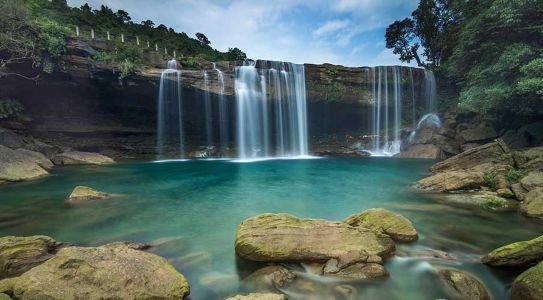
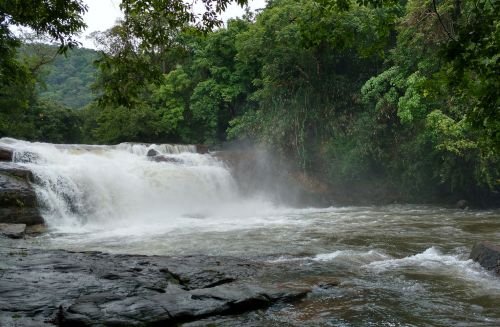
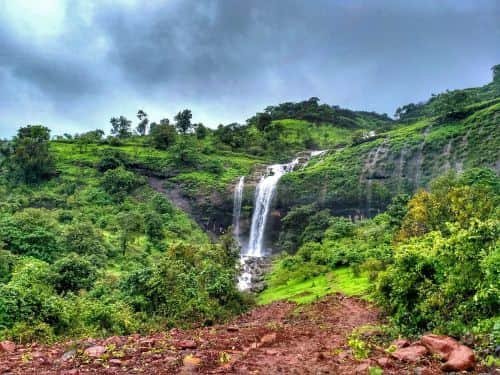
Chunchanakatte is different from the steep mountain waterfalls usually associated with Karnataka. Here, the Kaveri River spreads across a broad rocky bed, divides into separate streams and drops about 20 metres before coming together again downstream. The result is a wide, powerful river cascade that becomes particularly impressive when the Kaveri carries strong monsoon and post-monsoon flow.
Located near Chunchanakatte village in Saligrama taluk of Mysuru district, the waterfall is roughly 55 km from Mysuru and about 14 km from KR Nagar. Beside it stands the historic Sri Kodandarama Temple, giving Chunchanakatte both natural and religious importance.

Chunchanakatte Waterfalls: Quick Facts
- Location: Chunchanakatte, Saligrama taluk, Mysuru district, Karnataka
- River: Kaveri (Cauvery)
- Height: About 20 metres/60–65 feet
- Width: Roughly 300–400 feet during substantial flow
- Distance from Mysuru: About 54–56 km
- Distance from KR Nagar: About 14 km
- Distance from Saligrama: About 7 km
- Current commonly listed timing: Around 7:00 AM–6:30 PM
- Entry fee: Generally free
- Trek required: No major trek
- Best waterfall season: June to December
- Peak flow: Monsoon and early post-monsoon
- Recommended visit: 1–2 hours
- Major nearby attraction: Sri Kodandarama Temple
What Makes Chunchanakatte Waterfalls Special?
Chunchanakatte is a river waterfall rather than a narrow mountain cascade. As the Kaveri reaches the rocky ledge, it separates into two principal streams before dropping and rejoining downstream. Mysuru tourism information describes the waterfall as about 60 feet high and roughly 300–400 feet wide.
That width is what makes Chunchanakatte visually impressive. During strong flow, a large section of the rocky riverbed becomes covered by fast-moving white water.
The waterfall also sits immediately beside the Kodandarama Temple. Local tradition connects Chunchanakatte with the Ramayana and the tribal couple Chuncha and Chunchi. One of the site’s best-known traditions is that despite the powerful roar outside, the waterfall’s sound is said to become inaudible inside the temple’s sanctum.
These stories are part of the site’s religious tradition rather than historical or scientific claims, but they are an important part of the experience for pilgrims.
Chunchanakatte Waterfalls Timings
There is some inconsistency in published timings.
A recently updated 2026 Mysuru destination guide lists the waterfall at:
7:00 AM to 6:30 PM, with free public access.
Another current visitor listing shows approximately 6:30 AM to 8:00 PM, while some older travel sites describe the natural site as having unrestricted hours.
Because these sources do not agree, it is safer to plan Chunchanakatte as a daylight attraction rather than depending on a late closing time.
For most visitors, 8 AM to 5 PM is a practical window.
Morning is particularly useful if you want to visit both the waterfall and Kodandarama Temple without rushing.
Chunchanakatte Waterfalls Entry Fee
Current Mysuru tourism information describes general entry to the falls as free.
There may still be small charges for facilities such as:
- Vehicle parking
- Toilets
- Temple services or offerings
- Special local facilities
Carry some cash, particularly if you plan to visit the temple as well.
Is Trekking Required?
No major trek is required to see Chunchanakatte.
The destination has developed visitor areas, paths and viewpoints. Recent visitor information also mentions a watchtower, seating, children’s facilities and restrooms around the attraction.
You should still expect some walking around the waterfall and temple complex, but this is very different from a forest waterfall requiring several kilometres of trekking.
The normal experience is suitable for families, provided children are kept well away from the river edge.
Best Time to Visit Chunchanakatte Waterfalls
June to September
Mysuru tourism information identifies June to September as the main season, when monsoon rainfall increases the Kaveri’s flow and makes the waterfall much more impressive.
The disadvantage is that the river can become extremely powerful. Wet rocks should be avoided completely.
October to December
This can be an excellent period for travellers who want substantial post-monsoon flow with generally easier weather.
A current local field guide recommends the broader July–December period for the waterfall.
January and February
Waterfall volume depends on upstream conditions, but the period is important culturally because the annual Brahma Rathotsava associated with Kodandarama Temple takes place around Makara Sankranti.
March to May
Flow can reduce significantly during the dry season. If the waterfall itself is your main reason for visiting, monsoon or early post-monsoon is preferable.
How to Reach Chunchanakatte Waterfalls
From Mysuru
Chunchanakatte lies approximately 54–56 km from Mysuru.
A practical route is:
Mysuru → Yelwal/Bilikere → KR Nagar → Saligrama side → Chunchanakatte
Allow around 1.5 hours depending on traffic and your starting point in Mysuru.
Once you reach KR Nagar, continue towards Saligrama/Chunchanakatte. The final road leads directly towards the waterfall and temple area.
From KR Nagar
KR Nagar is the nearest useful town and is approximately 14 km from Chunchanakatte.
The broad route is:
KR Nagar → Saligrama Road → Chunchanakatte village → Waterfall
Government and private buses operate between KR Nagar and Chunchanakatte, making this one of the easier rural waterfalls around Mysuru to reach without a private vehicle.
From Bengaluru
For a road trip from Bengaluru, travel first towards Mysuru and then turn towards the KR Nagar side.
A broad route is:
Bengaluru → NH 275 → Mysuru outskirts → KR Nagar → Chunchanakatte
Because the waterfall is well beyond Mysuru, a Bengaluru same-day return is possible but makes for a long road journey. Staying in Mysuru provides a more relaxed trip.
By Bus
Public transport is available.
Current tourism information recommends travelling from Mysuru to KR Nagar, followed by local bus or road transport to Chunchanakatte.
Older Karnataka destination information also confirms that both government and private transport operate from KR Nagar to Chunchanakatte.
For a family or group, hiring a taxi from Mysuru may be more convenient.
By Train
Krishnarajanagara Railway Station is geographically closer, while Mysuru Junction provides much better long-distance connectivity.
Current route information places KR Nagar roughly 14 km from the waterfall, whereas Mysuru is approximately 55 km away.
For travellers arriving from Bengaluru or another major city, Mysuru Junction is usually the simpler choice because of its wider train network.
Continue from the station by taxi or bus.
By Air
For air travellers, Mysuru Airport is the nearest regional airport.
Flight availability is more limited than at Bengaluru, so Kempegowda International Airport in Bengaluru may be more practical for travellers arriving from cities without a direct Mysuru flight.
From either airport, the remaining journey is by road.
Sri Kodandarama Temple
Do not visit Chunchanakatte only for the waterfall and overlook the temple beside it.
The ancient Sri Kodandarama Temple is dedicated to Lord Rama and has several unusual traditions associated with it. One distinctive feature of its iconography is that Sita is positioned to Rama’s right, rather than the more common left-side placement.
The site is also associated with the tradition that Rama, Sita and Lakshmana stayed here during their exile.
Another widely repeated local belief concerns the waterfall’s roar: although the cascade is extremely loud outside, tradition says it cannot be heard inside the sanctum.
The temple and waterfall can easily be visited together.
Nearby Places to Visit
KR Nagar
Krishnarajanagara is approximately 14 km away and is the main transport town for Chunchanakatte. It is useful for food, fuel and onward bus or rail connections.
Arkeswara Swamy Temple
Arkeswara Swamy Temple near KR Nagar is another religious site on the banks of the Kaveri. Karnataka destination information specifically recommends it as an attraction to combine with Chunchanakatte.
Kappadi Kshetra
Kappadi is another local pilgrimage site that can be included if you are exploring the KR Nagar region rather than making a waterfall-only trip.
Balamuri and Yedamuri Falls
Balamuri and Yedamuri are popular Kaveri-side attractions closer to Mysuru. They are not immediately beside Chunchanakatte, but they work as part of a broader Kaveri-focused road itinerary.
Ranganathittu Bird Sanctuary
Ranganathittu is another important Kaveri attraction near Mysuru. It is particularly worthwhile for travellers interested in birds and river landscapes.
Because it is on a different side of the city, allow enough travel time rather than treating it as a five-minute stop after Chunchanakatte.
For a relaxed day, a simpler plan is:
Mysuru → KR Nagar → Chunchanakatte Waterfalls & Kodandarama Temple → KR Nagar → Mysuru
Can You Swim at Chunchanakatte Waterfalls?
Do not treat Chunchanakatte as a swimming waterfall.
The Kaveri can carry powerful currents, particularly during monsoon and periods of high discharge. Mysuru tourism information explicitly notes that swimming may be prohibited because of strong currents and advises visitors to check local rules.
Older visitor reports also document restrictions on entering the waterfall area after fatal accidents.
Even when water appears calmer:
- Do not walk onto wet rocks near the drop.
- Do not cross safety barriers.
- Avoid deep sections of the river.
- Do not assume low water means weak current.
- Keep children away from the edge.
Enjoy the waterfall from the designated viewing area instead.
Safety Tips for Chunchanakatte
The main risk here is the Kaveri River itself, not a difficult trek.
Keep these precautions in mind:
- Stay within designated visitor areas.
- Never climb onto wet river rocks.
- Do not swim near the waterfall.
- Do not cross barriers for photographs.
- Keep children closely supervised.
- Wear footwear with good grip.
- Be especially cautious during monsoon.
- Follow local instructions if river access is closed.
- Avoid standing close to fast-moving channels.
- Never enter the water simply because other visitors are doing so.
- Carry drinking water and basic snacks.
- Keep the temple and riverbank free of plastic waste.
The waterfall is broad rather than extremely tall, but that should not be mistaken for a gentle river. During strong flow, the Kaveri carries considerable force.
Chunchanakatte Waterfalls FAQs
Q1. What are the timings of Chunchanakatte Waterfalls?
A: A recent 2026 Mysuru destination guide lists 7:00 AM to 6:30 PM, while other listings show different hours. Since there is no consistently published government gate schedule, plan your visit during daylight, preferably between about 8 AM and 5 PM.
Q2. How far is Chunchanakatte Waterfall from Mysuru?
A: Chunchanakatte is approximately 54–56 km from Mysuru and around 14 km from KR Nagar. The road journey from Mysuru generally takes around 1.5 hours.
Q3. Is there an entry fee for Chunchanakatte Waterfalls?
A: General waterfall access is currently described as free by Mysuru tourism information. Parking or other facilities may have separate small charges.
Q4. What is the best time to visit Chunchanakatte Waterfalls?
A: June to September is the main monsoon season and provides powerful waterfall flow. October to December can offer an excellent balance of good water volume and more comfortable weather.
Q5. Is Chunchanakatte safe for swimming?
A: Swimming should be avoided, particularly during strong river flow. Current Mysuru tourism information warns that swimming may be prohibited because of powerful currents, and past accidents have led to restrictions around the falls. Use the designated viewpoints instead.