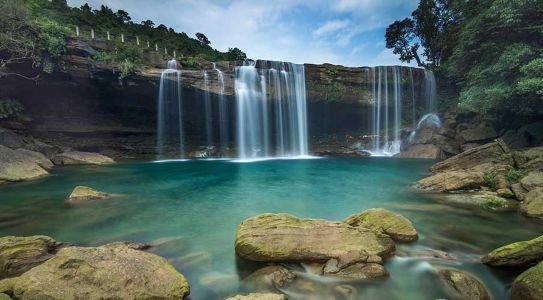
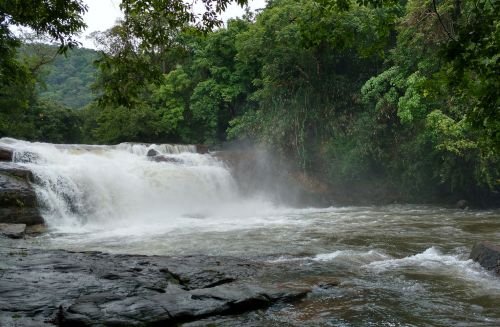
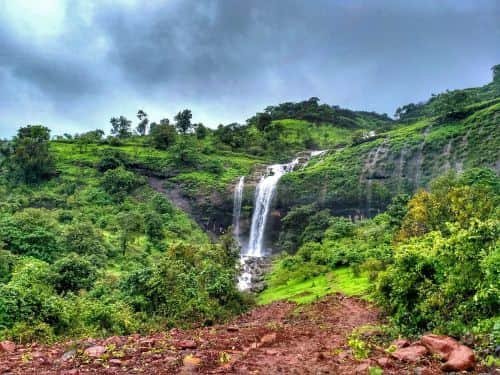
Gudguda Waterfall rewards travellers twice: first with the drive through the quiet countryside of western Odisha, and then with a series of cascades hidden among forested hills. Located in Sambalpur district near the Kuchinda region, Gudguda is surrounded by dense vegetation, mango and litchi orchards and rocky streams. The Sambalpur district administration officially lists Gudguda as one of the district’s recognised tourist attractions.
Unlike a single tall plunge waterfall, Gudguda is known for multiple step-like cascades flowing over natural rock formations. The district administration specifically describes three step-by-step waterfalls and also recommends the area for mountain trekking.

Gudguda Waterfall: Quick Facts
- Location: Gudguda, Sambalpur district, Odisha
- Nearest useful town: Kuchinda
- Distance from Sambalpur: About 115 km according to the district tourism page
- Distance from Jharsuguda: About 75 km by the official rail-distance reference
- Waterfall type: Multi-stage rocky cascades
- Surroundings: Dense forest, hills, mango and litchi orchards
- Official fixed timings: Not clearly published by Sambalpur district tourism
- Common visitor timings: Approximately 6 AM–6/7 PM
- Entry: Small eco-tourism/local charges may apply
- Best time: Post-monsoon through winter
- Trekking: Short walks and rocky hill sections
- Nearest major railway station: Jharsuguda Junction according to the district tourism page
- Nearest airport today: Veer Surendra Sai Airport, Jharsuguda
What Makes Gudguda Waterfall Special?
Gudguda is better understood as a waterfall landscape rather than one enormous vertical drop.
The official Sambalpur tourism description identifies three successive waterfalls carved naturally through the rocks. Cold water moves through a heavily shaded forest environment where relatively little direct sunlight reaches the stream.
The approach itself is another attraction. Before reaching Gudguda, travellers pass through countryside with extensive mango and litchi orchards. The district tourism department notes that visitors travelling in April and May can also experience the area’s litchi season.
Gudguda is officially recognised as a tourist centre in Odisha: the state’s 2026 list of identified tourist centres includes Gudguda under Sambalpur district.
Gudguda Waterfall Timings
The Sambalpur district’s official Gudguda page does not provide a precise daily opening-and-closing timetable. For that reason, it would be misleading to present one online timing as an official government schedule.
Non-government visitor listings vary. Some use approximately 6:00 AM–7:00 PM, while another regional tourism listing uses 8:00 AM–6:00 PM.
For practical planning, visit during daylight:
Recommended arrival: 7:00–10:00 AMRecommended departure: Before 5:00 PM
An early start is especially useful if you are travelling from Sambalpur or Jharsuguda because Gudguda is relatively remote.
Avoid planning an evening return from the waterfall. The final countryside and forest roads have limited tourist infrastructure.
Gudguda Waterfall Entry Fee
Current online sources disagree about the tariff.
One regional tourism source lists ₹10 per person and ₹50 for a four-wheeler, while another reports ₹5 per person, ₹20 for a motorcycle and ₹100 for a car.
The official Sambalpur district tourism page does not publish a current tariff.
Therefore, treat these prices as indicative rather than guaranteed. Carry cash and check the displayed charge at the authorised entrance or parking point.
Do You Need to Trek to Gudguda Waterfall?
Some walking is required if you want to explore the cascades properly, but Gudguda is not generally presented as a long, technical trek.
The Sambalpur district administration specifically recommends carrying trekking shoes and describes the location as suitable for mountain trekking.
Expect:
- Uneven forest paths
- Rocky sections
- Wet surfaces
- Short climbs
- Stream crossings
- Slippery rocks after rain
The different waterfall levels require more walking than simply reaching the picnic area.
Visitors with elderly family members or young children can enjoy the easier accessible sections without attempting every rocky level.
Best Time to Visit Gudguda Waterfall
July to September
Monsoon transforms the surrounding forest and increases waterfall flow.
However, this is also when stream crossings and rocky surfaces can become most dangerous. The official district page warns that even the small water crossing on the approach can become difficult for low-clearance vehicles during monsoon.
October to November
For nature lovers, this is arguably the best balance.
The forest remains green after the rains, water flow is normally healthy, and travelling conditions can be easier than during peak monsoon.
December to February
Winter is especially popular for family picnics. Regional tourism information identifies October–February as a particularly favourable period.
Be prepared for larger crowds around Christmas, New Year and winter weekends.
April and May
The waterfall may have less water, but the surrounding area is known for litchi orchards. Sambalpur district tourism specifically notes the litchi experience during April and May.
For a first visit focused mainly on the waterfall, October to February is the easiest period, while late monsoon provides a greener and more powerful waterfall experience.
How to Reach Gudguda Waterfall
From Sambalpur
The official Sambalpur tourism page places Gudguda approximately 115 km from the district headquarters.
The practical road journey heads towards the Kuchinda region before continuing into the rural interior.
Because online distance estimates vary considerably depending on the starting point and road used, allow around 3 hours or more from Sambalpur rather than planning solely from kilometre figures.
A private car or hired taxi is much more convenient than relying entirely on public transport.
From Jharsuguda
Jharsuguda is one of the best starting points for Gudguda.
The Sambalpur district administration gives detailed directions:
Jharsuguda → Kolabira → Kuchinda → Kusumi → Gudguda
From Jharsuguda, take the road towards Kolabira. At Kolabira, continue on the Kuchinda road. From Kuchinda, proceed towards Kusumi and then take the local road for roughly another 10 km towards Gudguda.
The district administration states that the journey from Jharsuguda takes approximately 1.5 hours, although real travel time can be longer depending on your starting point, weather and road conditions.
From Kuchinda
Kuchinda is the most useful town close to the waterfall.
Current regional route information places Gudguda approximately 30–31 km from Kuchinda.
The broad route is:
Kuchinda → Kusumi → Gudguda
Fill fuel, buy food and collect other essentials in Kuchinda because facilities become much more limited as you move towards the waterfall.
By Bus
Public transport can get you to Kuchinda, but reaching Gudguda itself is less convenient.
A practical public-transport plan is:
Bus to Kuchinda → hired local vehicle/taxi → Gudguda
Regional tourism information identifies Kuchinda as the nearest useful bus stop, approximately 30 km from the waterfall.
If using a hired vehicle, arrange your return trip before entering the waterfall area rather than expecting to find transport later.
By Train
The official Sambalpur district tourism page identifies Jharsuguda as the nearest railway station, giving a distance of approximately 75 km from Gudguda.
Jharsuguda Junction has much better long-distance connectivity than smaller stations in the surrounding region.
From Jharsuguda:
Jharsuguda Junction → Kolabira → Kuchinda → Kusumi → Gudguda
Hire a taxi or use a combination of road transport to Kuchinda and a local vehicle for the final section.
By Air
The Sambalpur district tourism page is outdated on air access because it still describes Jharsuguda airport as being under construction.
Today, Veer Surendra Sai Airport at Jharsuguda is operational, making Jharsuguda the practical air gateway for Gudguda.
From the airport, continue by road towards:
Jharsuguda → Kolabira → Kuchinda → Kusumi → Gudguda
This is considerably more practical than flying to Bhubaneswar or Raipur solely for the waterfall.
Road Conditions Near Gudguda
The official district description says the road becomes particularly pleasant after Kolabira, with very little traffic and extensive forest and orchard scenery.
However, there is an important monsoon issue.
Before reaching the main spot, visitors may need to negotiate a small water crossing. The district tourism page says four-wheelers can normally cross it, but low-clearance vehicles can have difficulty during monsoon.
Therefore:
- Avoid very low-clearance vehicles during heavy rain.
- Do not attempt a flooded crossing.
- Ask locally if unsure about water depth.
- Fill fuel before entering the remote section.
- Download an offline map.
- Avoid reaching after dark.
Nearby Places to Visit
Kuchinda
Kuchinda is the nearest practical town and the best place to stop for fuel, food and basic supplies before heading towards Gudguda.
It also provides the main road connection between the waterfall and Jharsuguda.
Ushakothi (Badrama) Wildlife Sanctuary
Ushakothi, also known as Badrama Wildlife Sanctuary, is one of Sambalpur district’s officially identified tourist attractions. The district tourism department places it about 37 km from Sambalpur along NH 53 and notes that entry is through Badrama village, where permission can be obtained from the Forest Range Officer.
Treat it as a separate forest visit rather than a quick roadside stop.
Hirakud Dam
Hirakud is one of western Odisha’s major attractions. The district tourism department places it around 16 km from Sambalpur and highlights the dam, reservoir, dykes, viewpoints and boating facilities.
Because Gudguda lies much farther from Sambalpur, combining both works better on a two-day western Odisha trip.
Samaleswari Temple
Located in Sambalpur city, Samaleswari Temple is one of the region’s most important religious sites. The district tourism department describes Goddess Samaleswari as the presiding deity of Sambalpur.
It is an easy addition if you are staying overnight in Sambalpur.
Huma Leaning Temple
Huma is approximately 26 km from Sambalpur and is known for its unusual leaning Shiva temple beside the Mahanadi.
It is better combined with Sambalpur and Hirakud than squeezed into the same day as a long Gudguda journey.
A relaxed two-day plan could be:
Day 1: Sambalpur → Hirakud → Samaleswari TempleDay 2: Sambalpur/Jharsuguda → Kuchinda → Gudguda Waterfall
Safety Tips for Gudguda Waterfall
Gudguda’s remote setting is part of its appeal, but it also means visitors should be more self-sufficient.
- Wear shoes with strong grip.
- Do not climb slippery waterfall rocks.
- Avoid deep natural pools.
- Never dive into unfamiliar water.
- Be especially careful during monsoon.
- Do not attempt a flooded road crossing.
- Start early and return before sunset.
- Carry drinking water and food.
- Keep a basic first-aid kit.
- Download offline directions.
- Avoid loud music in the forest.
- Do not consume alcohol around the waterfall.
- Do not feed or approach wildlife.
- Carry all plastic and rubbish back.
- Follow any instructions from forest personnel.
Some non-government tourism material specifically instructs visitors not to swim or dive in the waterfall area, even though other travel pages describe bathing in smaller pools. Given the changing depth and current, the safer approach is to avoid swimming and use only areas explicitly permitted locally.
Gudguda Waterfall FAQs
Q1. What are the timings of Gudguda Waterfall?
A: The Sambalpur district tourism page does not publish a precise official daily schedule. Non-government sources commonly list approximately 6 AM–6/7 PM. For a safe visit, arrive in the morning and leave before sunset.
Q2. How far is Gudguda Waterfall from Sambalpur?
A: The Sambalpur district administration places Gudguda approximately 115 km from the district headquarters. Other online sources give shorter figures, likely because they use different starting points or routes. For trip planning, the official district figure is the safer reference.
Q3. How far is Gudguda Waterfall from Kuchinda?
A: Current regional route information places Gudguda roughly 30–31 km from Kuchinda. The route continues through the Kusumi side into the forested waterfall area.
Q4. Is trekking required at Gudguda Waterfall?
A: Some walking and climbing over uneven terrain is involved, especially if you want to explore the different waterfall levels. The Sambalpur district administration recommends carrying trekking shoes and identifies Gudguda as suitable for mountain trekking.
Q5. What is the best time to visit Gudguda Waterfall?
A: For comfortable weather and picnics, October to February is an excellent period. Monsoon and early post-monsoon provide stronger flow and greener surroundings but also make rocks, streams and road crossings more dangerous. The area can become particularly crowded around Christmas and New Year.