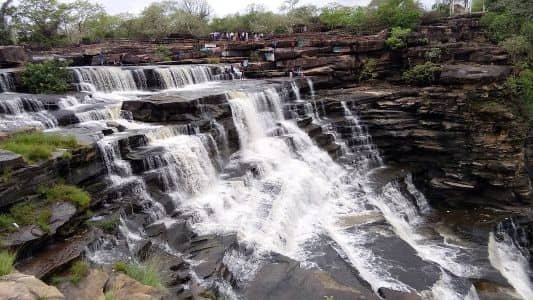
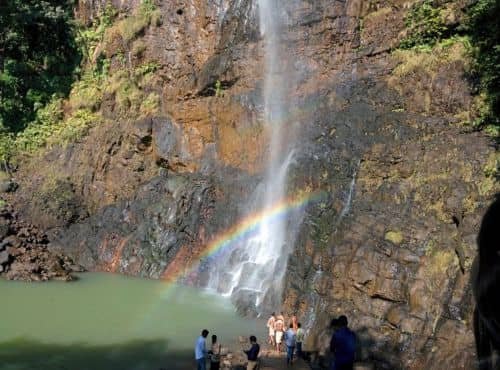
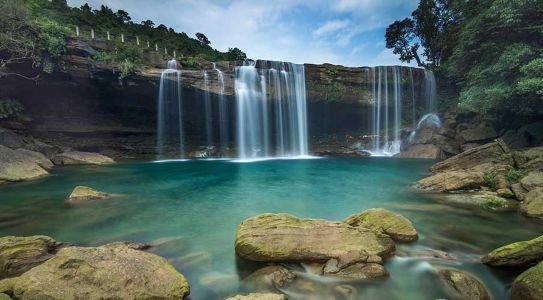
Badlapur’s monsoon landscape changes dramatically once you leave the town and move towards the hills around Kondeshwar. Seasonal streams appear beside village roads, the surrounding Sahyadri slopes turn green, and waterfalls begin flowing through the basalt cliffs. Dhangar Waterfall is one of these seasonal attractions, located in the Badlapur–Kondeshwar region and reached through the rural Dhangarwadi/Bendshil side.
Unlike waterfalls developed with viewing galleries and ticket counters, Dhangar remains relatively natural. The final approach involves a short walk through forest and rocky terrain, while the waterfall itself becomes impressive only after sufficient monsoon rainfall. Recent route information places it roughly 8–9 km from Badlapur Railway Station.
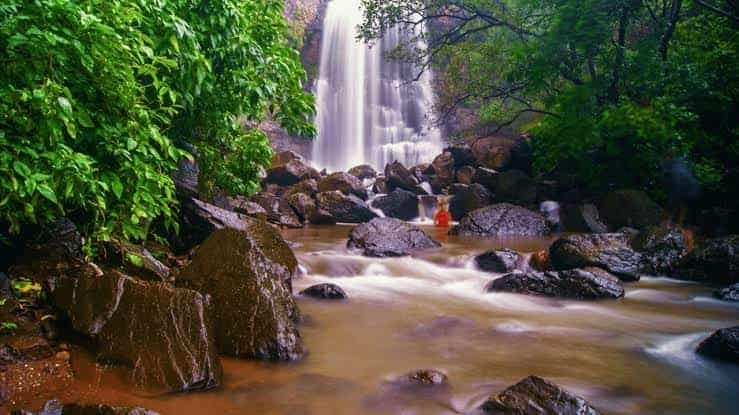
Dhangar Waterfall: Quick Facts
- Location: Badlapur–Kondeshwar region, Maharashtra
- Nearest town: Badlapur
- Distance from Badlapur Railway Station: About 8–9 km
- Type: Seasonal monsoon waterfall
- Approximate height: Around 25–30 metres according to local trekking records
- Trek: Short walk; exact distance varies with approach
- Difficulty: Easy under normal conditions
- Timings: No verified official fixed hours
- Recommended visit: Morning to late afternoon
- Entry fee: Generally free; local parking may apply
- Best season: June to September
- Best flow: Usually July and August
- Nearest railway station: Badlapur
- Main risk: Deep pools and sudden heavy water flow during intense rain
Where Is Dhangar Waterfall?
Dhangar Waterfall lies in the hills around Badlapur and Kondeshwar, with older trekking documentation placing it near Kondeshwar village and Bhoj Dam, against the Navara-Navari/Chanderi hill landscape.
Different online route descriptions use Dhangarwadi, Bendshil, Khuntavali and Kondeshwar as reference points. This can make the location look inconsistent when planning your first visit.
A recent 2025 route guide describes the main approach as:
Badlapur → Katrap → Barvi Road → Dhangarwadi → short walk to Dhangar Waterfall.
Because this is a rural waterfall rather than a formal tourist complex, confirm the final trail locally instead of following an unfamiliar shortcut suggested by navigation.
What Makes Dhangar Waterfall Worth Visiting?
Dhangar is particularly suitable for visitors who want a short monsoon nature trip without committing to a long Sahyadri trek.
The waterfall drops through a rocky forested section surrounded by hills. An older local trekking record estimates the drop at approximately 25–30 metres, though there is no authoritative government measurement, so the figure should be treated as approximate.
Its setting is the stronger attraction. During monsoon, visitors encounter:
- Green Sahyadri slopes
- Seasonal streams
- Forest trails
- Rocky pools
- Views towards the Chanderi/Navara-Navari hill region
- Several smaller seasonal cascades
It is also much closer to Mumbai’s suburban railway network than many better-known Maharashtra waterfalls.
Dhangar Waterfall Timings
There is no reliable official government opening-and-closing timetable specifically for Dhangar Waterfall.
This is an undeveloped natural attraction rather than a gated waterfall park. For practical purposes, visit only during daylight.
A sensible schedule is:
Arrive at the base: 7:00–10:00 AMVisit waterfall: Morning to early afternoonStart returning: Before 4:00 PM
Avoid entering the forest or waterfall trail late in the evening. There is little infrastructure, and visibility deteriorates quickly in heavy monsoon cloud and rain.
Police may also restrict access during periods of dangerous rainfall. Older local trekking documentation specifically notes that the waterfall has been closed during very heavy rain because of dangerous water flow.
Dhangar Waterfall Entry Fee
There is currently no clearly established government admission ticket for Dhangar Waterfall.
A recent listing describes general access as free, while noting that limited village parking may be available.
You may still pay for:
- Local parking
- Auto-rickshaw transport
- Food in the base village
- Organised trekking or adventure activities
Do not confuse ordinary waterfall entry with commercial rappelling packages. Organised operators offer paid rappelling and flying-fox experiences at Dhangar, but these are separate activities rather than an admission fee for the waterfall.
How Difficult Is the Dhangar Waterfall Trek?
The normal approach is generally considered easy, but published distances differ because visitors start from different road points.
A 2025 route guide describes a 15–20 minute walk from near Dhangarwadi, while a recent waterfall-rappelling operator schedules roughly 30 minutes between the base village and waterfall. A 2026 visitor video describes an even shorter 5–10 minute final forest approach after reaching the closer drop-off point.
Rather than expecting one exact distance, plan for a short 15–30 minute walk under normal access conditions.
The trail can include:
- Mud
- Wet grass
- Small streams
- Uneven rocks
- Slippery surfaces
- Forest sections
The trek itself is not particularly demanding. Heavy rain is what can make it dangerous.
Best Time to Visit Dhangar Waterfall
June
The waterfall starts becoming active after sustained southwest monsoon rain. Early June flow can be weak if the monsoon has not properly established itself.
July and August
These are usually the most dramatic months.
Dhangar carries stronger water and the surrounding Badlapur hills become intensely green. Current route information identifies the monsoon as the waterfall’s main visiting season.
However, maximum flow also brings maximum danger.
Avoid visiting during extreme rainfall or immediately after exceptionally heavy overnight rain.
September
September can provide a better balance. The waterfall often retains good flow after a strong monsoon, while continuous heavy rainfall may become less frequent.
October to May
Flow gradually reduces after monsoon. Winter may still be pleasant for the countryside, but the waterfall itself can become weak.
Summer is not recommended if your main purpose is seeing Dhangar in full flow.
How to Reach Dhangar Waterfall
From Badlapur Railway Station
Badlapur is the easiest transport base.
Recent route information places Dhangar Waterfall approximately 8–9 km from Badlapur Railway Station.
The broad route is:
Badlapur Station → Katrap → Barvi Road → Dhangarwadi/base village → waterfall trail
From Badlapur station, hire an auto-rickshaw or local vehicle.
A 2026 visitor video reported paying approximately ₹300 for an auto carrying three people, but this is only one visitor’s experience and should not be treated as a fixed fare.
Agree on the fare and, preferably, the return journey before leaving Badlapur.
From Mumbai
The broad road route is:
Mumbai → Thane → Kalyan → Badlapur → Katrap → Barvi Road → Dhangarwadi
A recent guide estimates the journey at approximately 70 km from Mumbai, although actual distance varies considerably depending on your starting point.
During monsoon weekends, traffic around Thane, Kalyan and Badlapur can substantially increase travel time.
For many Mumbai residents, taking a local train to Badlapur is easier than driving.
From Pune
A commonly suggested road approach is:
Pune → Chakan → Murbad region → Badlapur → Dhangarwadi
One current route guide estimates roughly 125 km from Pune, with the journey taking about 3.5 hours under favourable conditions.
Road conditions on the final village section can deteriorate during heavy monsoon rain, so allow extra time.
By Train
Badlapur Railway Station is the most convenient railhead.
Badlapur lies on Mumbai’s Central suburban railway network, making Dhangar Waterfall practical for a day trip from Mumbai, Thane, Dombivli and Kalyan.
From the station:
Badlapur Station → auto/local vehicle → Dhangarwadi/base → walk to waterfall
Check the return train schedule before leaving the station, particularly if visiting on a crowded monsoon weekend.
By Bus
Local road transport can take you towards the Barvi Road/Kondeshwar side, but a direct public bus to the waterfall trailhead should not be assumed.
For first-time visitors, the easier public-transport combination is:
Train to Badlapur → auto or local vehicle to the base village → short trek
Confirm your return transport before starting the walk.
Nearby Places to Visit
Kondeshwar Temple
Kondeshwar is the most natural attraction to combine with Dhangar Waterfall. The historic Shiva temple sits in a forested setting outside Badlapur and is surrounded by streams and seasonal waterfalls during monsoon.
Dhangar is frequently described specifically as a waterfall in the Kondeshwar region.
Bhoj Dam
Older trekking records place Dhangar Waterfall near the Bhoj Dam landscape, making the reservoir area part of the surrounding scenery.
Reservoir edges can become dangerous during monsoon, so treat them as viewpoints rather than swimming locations.
Barvi Dam
Barvi Dam is another major water body in the Badlapur region. A recent Dhangar route guide places it approximately 5 km from the broader waterfall area, although the exact road distance depends on your approach.
Access restrictions around dam infrastructure should always be respected.
Chanderi Fort
Chanderi is a prominent mountain in the Badlapur region and is visible from parts of the Dhangar landscape. Local trekking records specifically mention the Chanderi/Navara-Navari range in the waterfall’s background.
Chanderi is a separate and substantially more demanding trek. Do not try to add it casually after a waterfall visit.
Chikhloli Dam
Chikhloli Dam is another local nature stop around Badlapur and is often included in lists of nearby monsoon attractions.
For most first-time visitors, however, a relaxed plan is simply:
Badlapur → Dhangar Waterfall → Kondeshwar Temple → Badlapur
Is Swimming Safe at Dhangar Waterfall?
It is better not to treat Dhangar as a swimming destination.
Local trekking documentation describes two pools around the base of the waterfall and warns that they can be deep. It also notes that the waterfall becomes particularly dangerous during heavy flow.
More importantly, an established operator currently running organised Dhangar waterfall activities explicitly states that swimming or entering streams is not allowed during its trips.
Recent local reviews also warn that the waterfall pool is deep and that serious accidents have occurred.
Enjoy the cascade from a stable location rather than jumping into an unfamiliar pool.
Safety Tips for Dhangar Waterfall
Dhangar looks approachable because the trek is short, but the waterfall becomes much more dangerous when the monsoon is intense.
Keep these precautions in mind:
- Avoid visiting during extreme rainfall.
- Never enter a deep waterfall pool.
- Do not stand directly under very heavy flow.
- Avoid crossing a rapidly rising stream.
- Wear trekking shoes with strong grip.
- Do not climb wet rock faces.
- Start early and return in daylight.
- Keep children away from deep pools.
- Carry sufficient drinking water.
- Do not attempt rappelling without trained professionals and proper equipment.
- Follow police or local restrictions immediately.
- Avoid alcohol around the waterfall.
- Keep phones and valuables waterproofed.
- Carry all rubbish back to the village.
The most important rule is simple: if water levels are rising or local police have closed access, turn back. Older trekking records specifically note police closures during dangerous heavy-flow conditions.
Dhangar Waterfall FAQs
Q1. What are the timings of Dhangar Waterfall?
A: There is no verified official daily opening-and-closing schedule for Dhangar Waterfall. It is best treated as a daylight-only natural attraction. Start in the morning and begin returning by late afternoon, especially during monsoon.
Q2. How far is Dhangar Waterfall from Badlapur Railway Station?
A: Recent route information places the waterfall approximately 8–9 km from Badlapur Railway Station. Take an auto or local vehicle towards Dhangarwadi/Kondeshwar and complete the final section on foot.
Q3. How long is the trek to Dhangar Waterfall?
A: The walking distance depends on where your vehicle stops. Recent sources range from about 5–10 minutes to 15–30 minutes for the final approach. Under normal access conditions, it is a short and relatively easy trek.
Q4. Is there an entry fee for Dhangar Waterfall?
A: There is no clearly established government entry ticket, and current destination information generally describes access as free. Local parking or organised adventure activities can cost extra.
Q5. What is the best time to visit Dhangar Waterfall?
A: June to September is the main season, with July and August usually offering stronger flow. September can be a better option if you want monsoon greenery with potentially easier conditions. Avoid visiting during extremely heavy rain because the waterfall, pools and streams can become dangerous.